

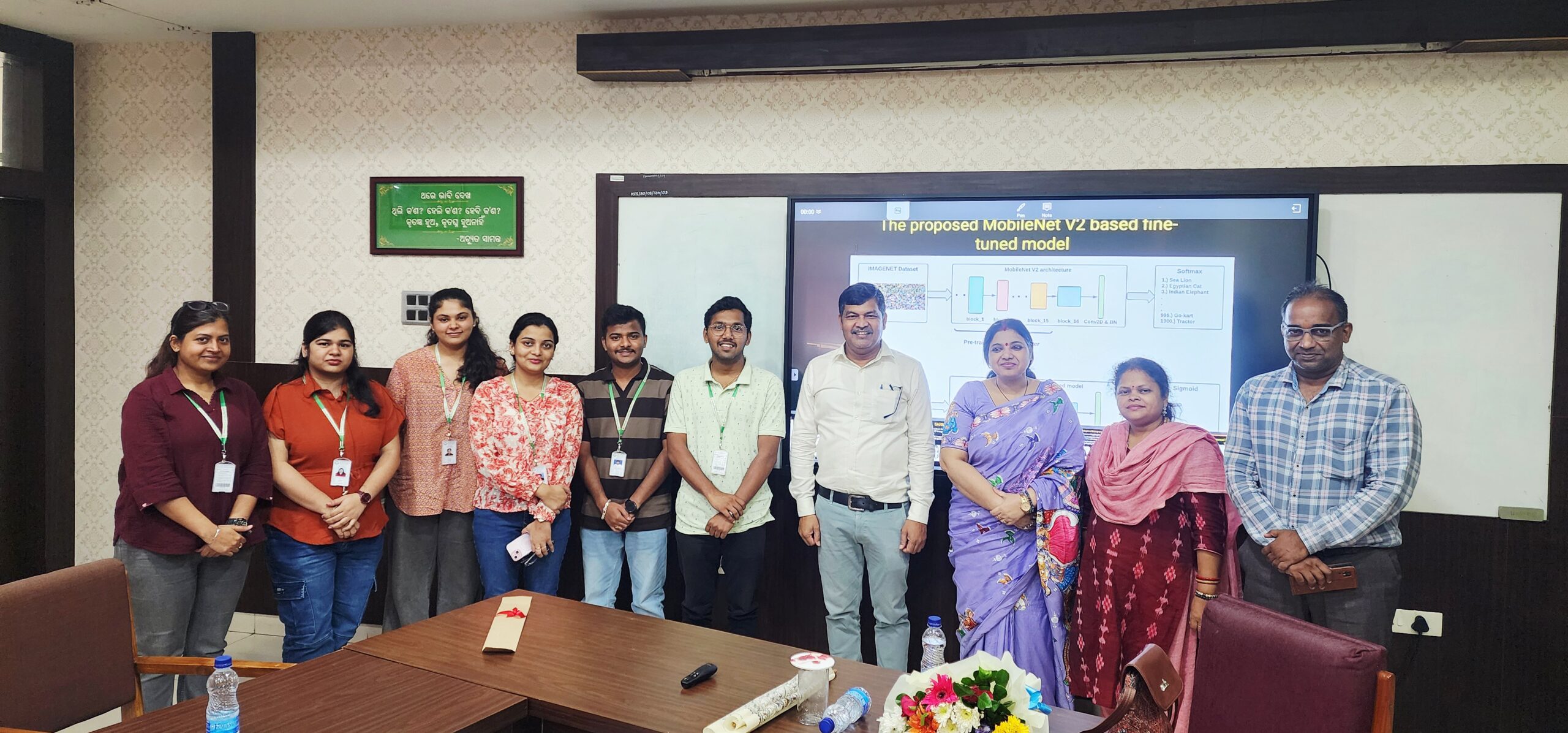
COIR – Behavioural & Neuroscience Organizes Expert Talk
The Kortex Club under the COIR – Behavioural & Neurosciences at KIIT School of Management organized a special talk by Dr. Maheshkumar H. Kolekar, Head, Department of Electrical Engineering, IIT Patna, on “Behavioural & Neuroscience Applications in the Age of AI” on 21st September 2026.
Dr. Shikta Singh, Head of COIR – Behavioural & Neurosciences, welcomed Dr. Kolekar to the session and also set the context. She emphasized the significance of the intersection of AI with the Behavioural & Neurosciences Discipline. The session brought together faculty members and researchers for a wide-ranging discussion on EEG, cognitive testing, brain fingerprinting, and the history and management applications of artificial intelligence.
Dr. Kolekar started off by explaining that when a subject is given a task to perform the brain is used and EEG is recorded during the process. Following EEG recording, it makes sense to look at the cognitive parameters, he noted, not just the EEG alone. He then spoke of another work on seizure detection, where seizure activity was classified into three types – seizure, healthy and pre-seizure. The goal is to predict a seizure before it happens so that appropriate measures can be taken in time like moving the person to a hospital, especially for people who experience seizures in remote places.
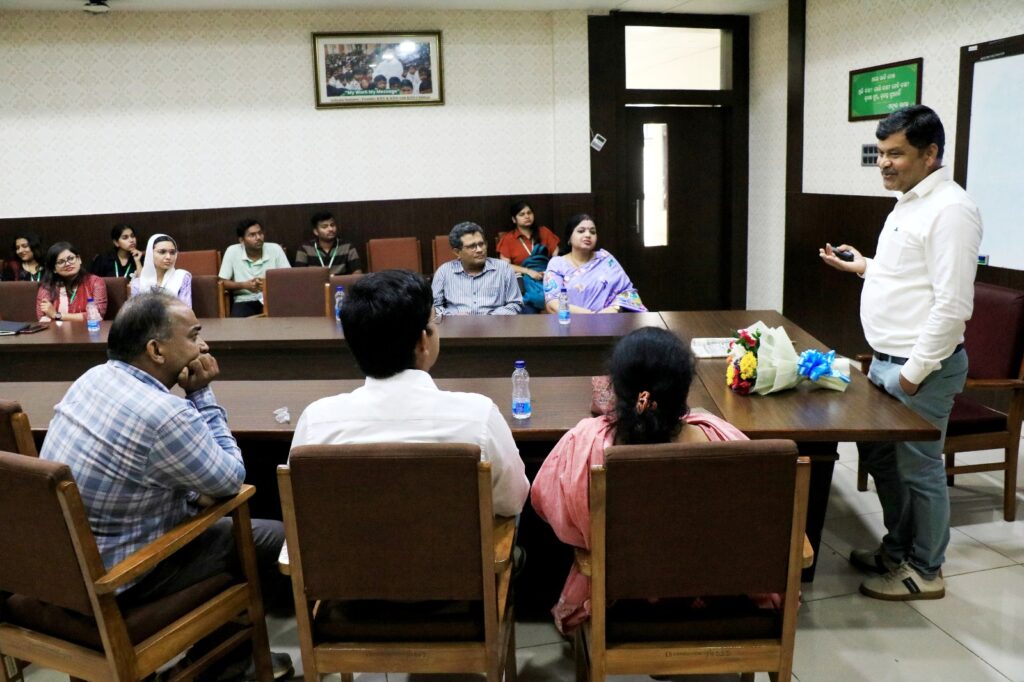
He discussed cognitive testing batteries for conditions like ADHD and the practical and financial challenges of acquiring and licensing clinical software. He also cited EEG in neuromarketing to study consumers’ responses to products and advertisements, often coupled with eye-tracking and facial emotion analysis. He then explained brain fingerprinting, based on his research at TU Berlin, where EEG and the P300 signal can help identify whether a person has previously come across information related to a crime. Finally, he traced the evolution of artificial intelligence from Rosenblatt’s 1957 artificial neuron and Hinton’s backpropagation algorithm to ImageNet, AlexNet, CNNs, and modern Generative AI, including GANs, Autoencoders, and Transformers, with chatgpt as an example of the Transformer architecture.
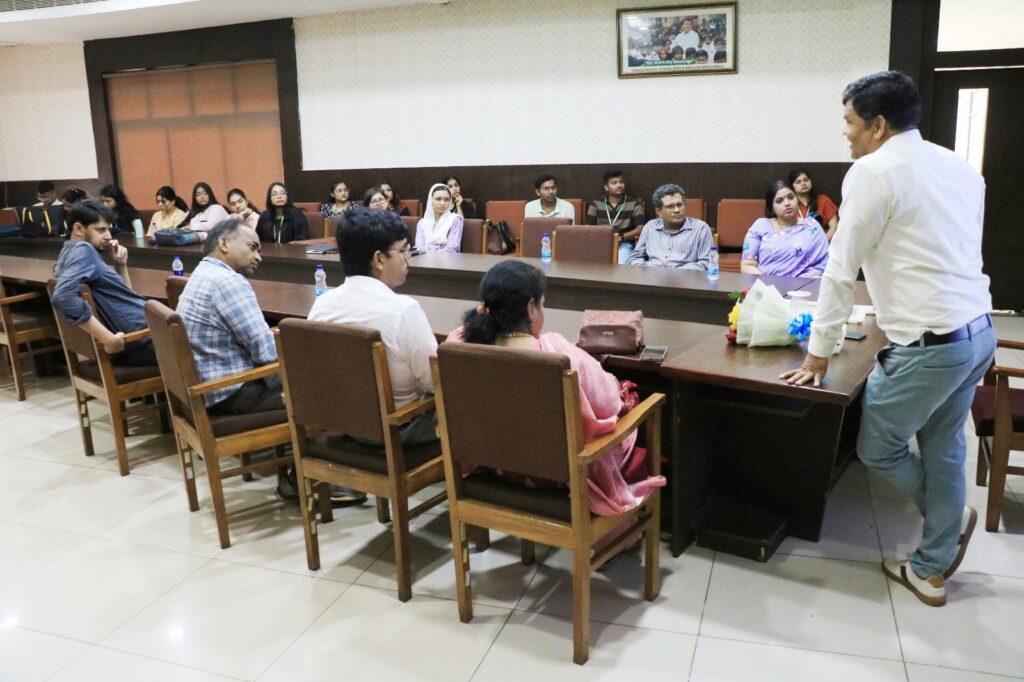
Faculty members, research scholars and students participated in the interactive discussion, which underscored the growing relevance of EEG-based cognitive neuroscience and artificial intelligence to management research and practice, while opening avenues for future collaborative work among the technical departments across the university.
Dr. Kolekar closed by connecting the discussion back to management, observing that AI is applicable wherever data exists – spanning classification and prediction problems relevant to business analytics, financial performance ranking and institutional benchmarking such as NIRF rankings – and encouraged deeper interdisciplinary collaboration between technical and management faculty, noting that such partnerships allow each side to compensate for the other’s domain gaps.